
God as Iconoclast
Musical Genres and Models of God (Part II - Punk)


Today’s post was written by Jimmy Brougher. He is someone who uses words exceptionally well and I am honored not only to consider him a friend, but a conversation partner about all things punk!
Written by Jimmy Brougher
July 4, 1976, 7pm, The Roundhouse, London:
The Ramones take the stage to deliver a Declaration of Independence, not FROM England, but TOO it (or 2000 citizens of it anyways)*.
In this second declaration, presented exactly 200 years after the first, they held these truths to be self-evident, that:
1. You can be you
2. Life was about living
3. NO ONE had the authority to tell you otherwise.
That was it, the punk movement was born. Granted, punks had been doing punk stuff for a few years, making aggressive music and art, looking weird, loitering... but it was all small, regional, disparate and VERY underground.
This was different.
The only band to have released an actual record of Punk Rock had come from across an ocean to present their offerings to a large unified congregation of like minded individuals primed for a call to action. This was Punk’s “coming out party.” It was a call to arms with marching orders: “HEY HO! LET’S GO!”
Four months prior, The Ramones had released the first actual Punk Rock artifact; a physical object you could hold in your hand, see with your eyes, listen to with your ears and feel in your heart: the Blitzkrieg Bop single.
Members of the what would become the UK’s most famous punk bands, The Sex Pistols and The Clash, were notably not there that night as they were performing 4 hours away at the same time (it was in fact The Clash’s very first live performance). They would have to come the next night to pay homage and take in for themselves what The Ramones had come to give. And take it in they did. As Johnny Rotten would put it a couple months later on their initial (and most infamous) recorded offering, Anarchy In The UK “I don’t know what I want but I know how to get it...destroy!” What those four boys from Queens were doing was very clear and very intentional and very American. Their logo (created by famed punk, Arturo Vega) said as much. As Dee Dee Ramone described it “A bald eagle with a baseball bat, what’s more American than that?!’ (I suppose the apple pie is implied)
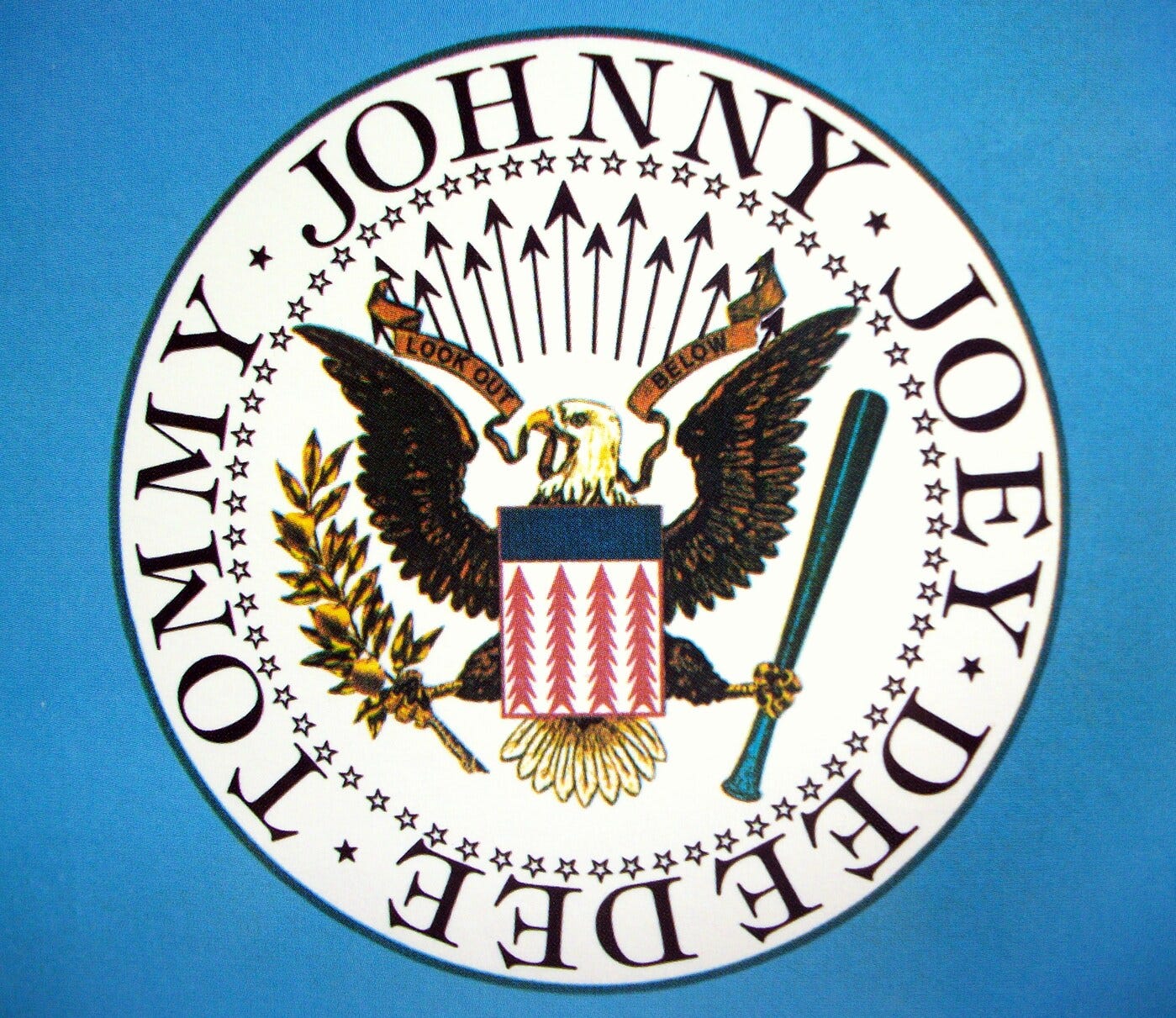
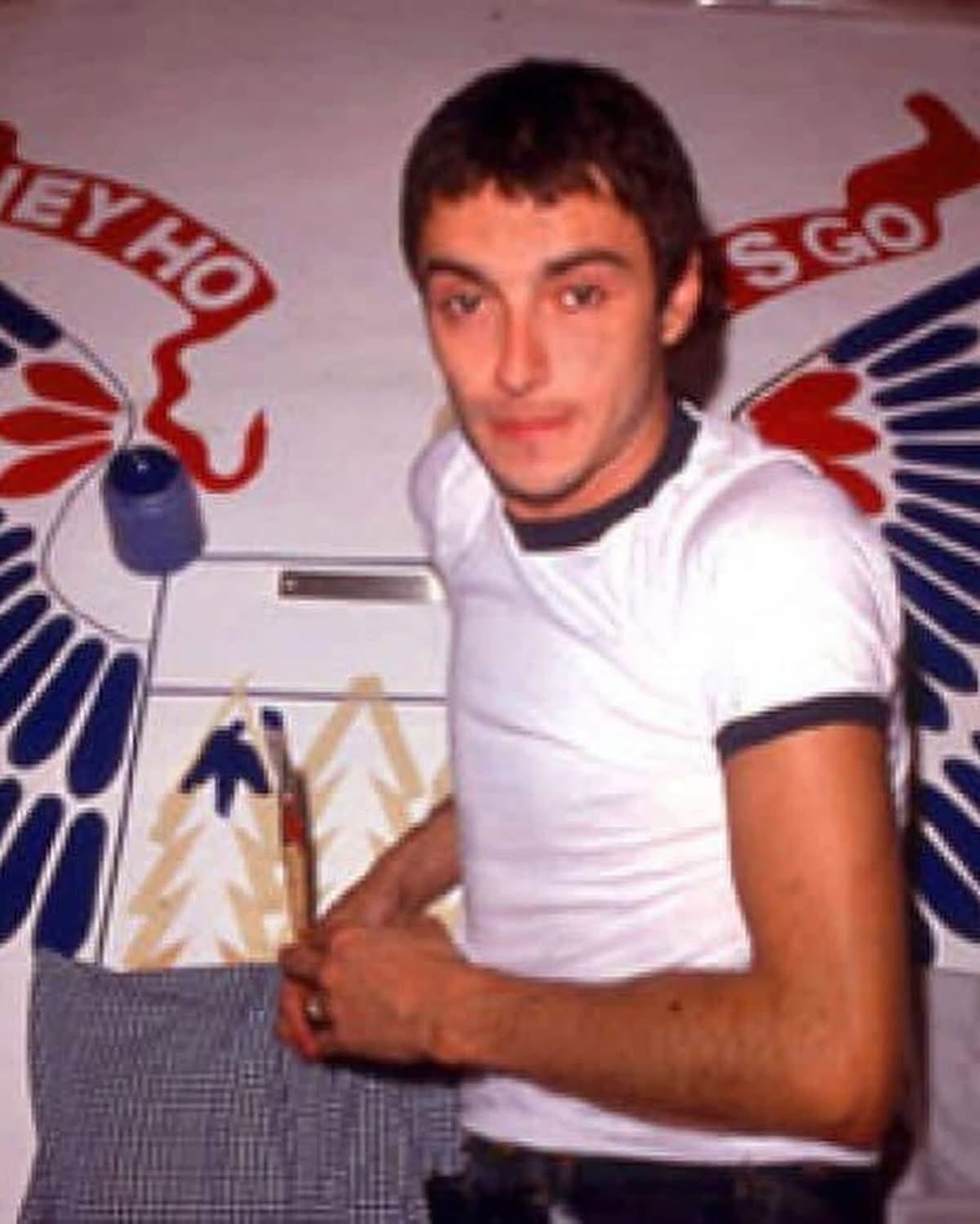
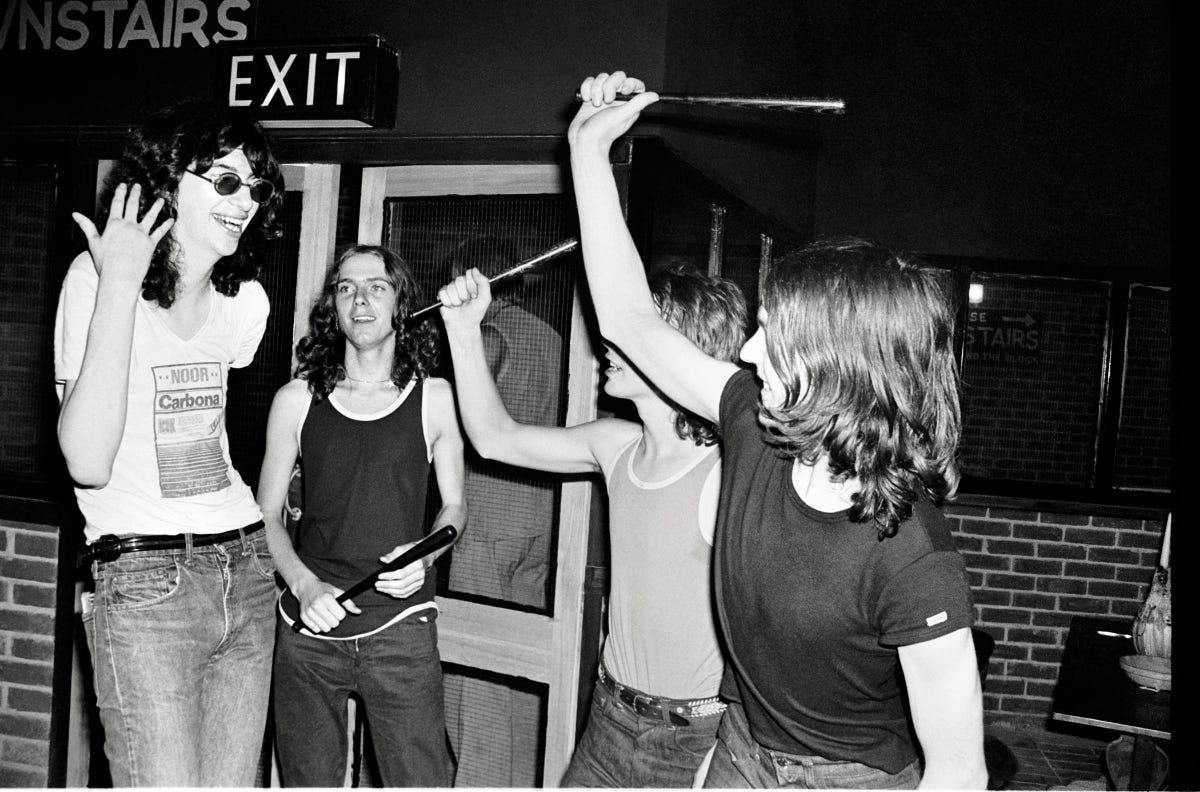
A baseball bat is not a subtle tool. The only question mark attached to it when a bat is in your hand is the one at the end of the sentence “what would be the most fun thing to hit with this right now?”
For the Ramones, the pulsing red bullseye was on the twin false idols of the self indulgent, self aggrandizing sonic meanderings of the prog and jam bands on one side (see YES, and The Grateful Dead), and the soulless/toothless corporate radio greed factory of the easy listening and stadium rock on the other (see Captain & Tennille and Boston). The youth of the day had been pied-pipered away and mesmerized into suckling at the teat of the golden cow of capitalism. Those four street urchins were hellbent on finding out how much blasphemous bullshit they could demolish with their one short** life - if only for their own sanity!
For them this was existential. The rock and roll they grew up with on the radio was a lifeline, a portal out of the malaise of the concrete jungle of 60’s New York City. Hearing people create landscapes of liberty and demonstrate that there WERE other ways to be, ways unconstrained by the rules handed down from “on high” that life consisted of Work-Sleep-Work-Die. And now that very portal had been commandeered and commodified to simply grease the tracks of the train that was hauling their peers off to fuel the furnace of fortune for the few.
Something human at the core of the American Experiment is the “self-evident” knowledge that we are no one’s possession, no one’s tool (ironic of course that people who could feel something so true inside themselves could then be so willfully blind to see it in others). Something about Johnny, Joey, Tommy and Dee Dee just wouldn’t let them sit idly by while their generation was being sacrificed to idols. Wielding the tools that had been handed to them by their forebears (Chuck Berry, Elvis, The Beatles, The Shangri-las, The Stones...) they took up the mantle of iconoclasts and set about recording and distributing incendiary sonic devices across the country and the world. To this day some of those same fires still burn and still liberate the world over, though once again The Machine found ways to transmute and incorporate the righteous indignation into a means for its own ends, but not completely, and often to its own detriment. Consider Green Day’s performance of “American Idiot” at the Super Bowl:
So on this the 250th anniversary of the iconoclastic nation that I was born into, and the 50th anniversary of the iconoclastic movement that helped set me free from bondage to that nation, I sit pondering the human impulse toward iconoclasm. Human history is the history of building and destroying monuments to things/ideas/people/gods who we decide, then un-decide, deserve our honor/respect/fealty/worship. For an interesting (if depressing) romp through our shared humanity, skim the Wikipedia entry on Iconoclasm:
https://en.wikipedia.org/wiki/Iconoclasm
There seems to be something in us that can’t help but be drawn to the transcendent (be it ‘divine’ or ‘scientific’ or whatever), and then be dogmatic (and usually militant) about our commitment to which ever “transcendental” we find most compelling in a given moment. Our self-defined helpfulness is at its peak in these moments and we volunteer our removal services for any and all monuments to opposing gods, so all may live as free from falsehood as we do. And round and round we go...
But what is it in us that does this? I’ve been thinking, what if it’s the “Imago Dei?” What if iconoclasm is part of the nature of God and therefore built into what it is to be humans made in the image and likeness of God? The religious tradition I come from has in its holy writings a constant stream of stories where God’s prime objective seems to be to undermine our efforts to systematize and codify who God is and what it looks like to be in right relationship with God.
To name a few:
The thwarting of the tower of Babel in Genesis 11
Moses meeting God in a burning bush in the desert in Exodus 3
God sending the prophet Jonah to help out a bunch of evil foreigners in the book of Jonah
The prophet Elijah meeting God in a still small voice on the mountain in 1 Kings 19
The prophet Amos saying God hates our sacrifices and celebrations and songs if we don’t care for our neighbors (particularly the poor) in Amos 5
And then, in what seems to be the most unexpected act of iconoclasm ever recorded, God climbs right off the monument altogether and into the crowd of mortals as Jesus of Nazareth. He is born a poor member of an oppressed colonized people, lives simply but beautifully, and eventually submits his own body as building material for the most extreme form of statuary then available. He became an inverted monument to oppression by exposing the emptiness of the claims of the oppressors. As described in the Gospels of Matthew, Mark, Luke, and John, his life was not taken, it was given and thus he subverted the entire project of intimidation and coercion that had been plaguing our existence for centuries.
So Maybe, on this our 250th birthday, like Carman said (but NOT like Carman meant) “We need God in America, again”
In that spirit, or maybe with that spirit, we can rethink the Ramones as inviting us to take more seriously the idea of God being the original iconoclast.
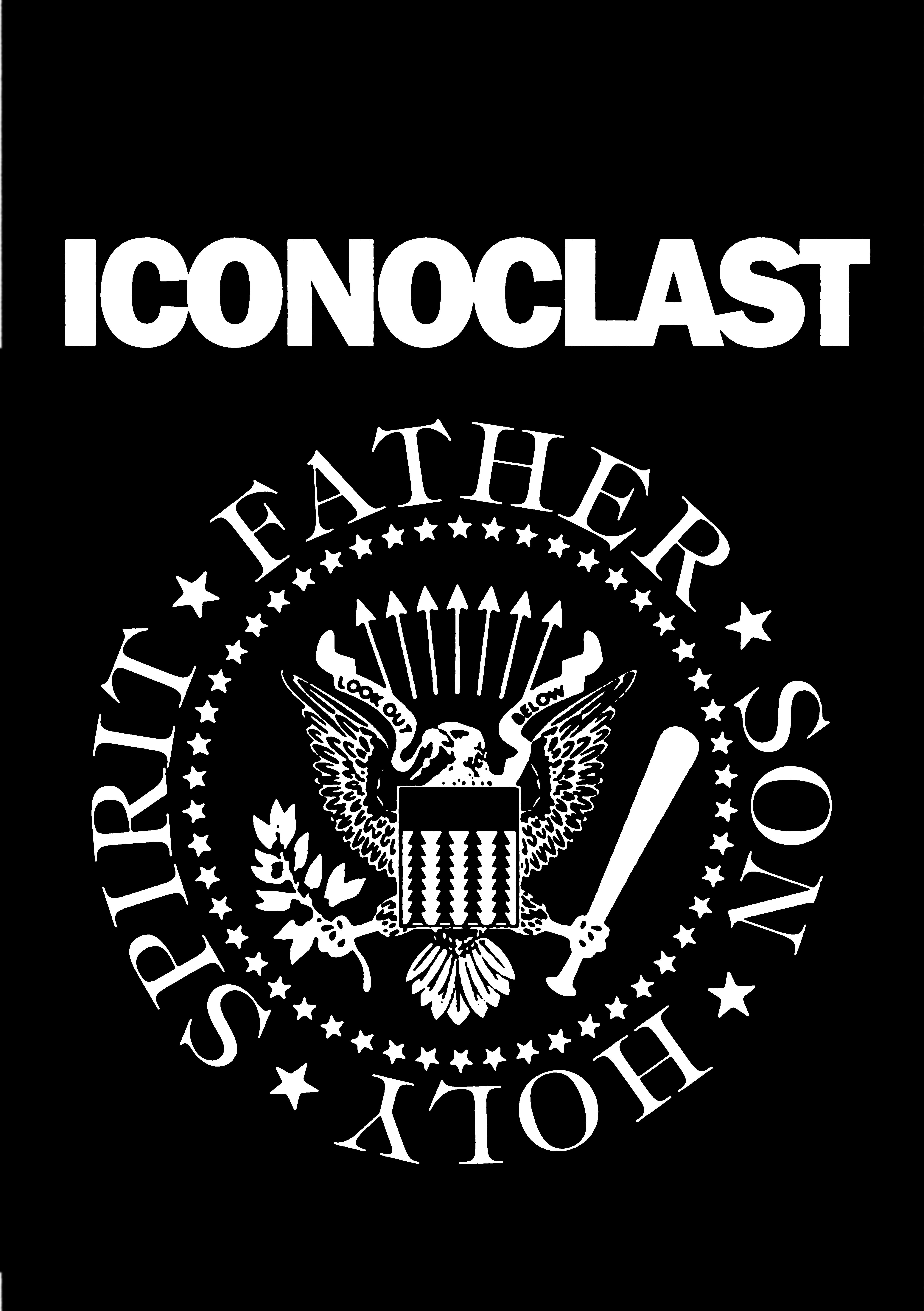
What punk music helps us understand is that when we think we have things figured out, we almost always have fallen back into the complacency of our own smugness. Being punk is not primarily about tearing down systems, but about interrogating those systems and opening spaces for new possibilities. If Christian churches became more punk, maybe they would do a better job of embodying the radical hospitality, the critical awareness, and the excessive logic of neighbor-love. If American society became more punk, maybe it would do a better job of living into the radical idea of democracy.
These are both tasks worthy of our “faithful” commitment.
Hey Ho, Let’s Go!
*for a brief oral history of that night see: https://louderthanwar.com/the-night-punk-went-overground-july-4th-1976-oral-account/
And some more photos:
https://www.vintag.es/2022/08/ramones-in-london.html?m=1
**Tommy, the oldest of the original four Ramones died age 65
 | A guest post by
|
https://jimgregg.substack.com/p/punk-profile-john-brown?r=48ys0&utm_medium=ios
Some essential rumination on a historical Christian+American+Punk+Iconoclast
And thanks to Zeph Mendonca for making the logo for me