
More than Words
On Lived Experience and the Limits of Expression

So, I ended up going camping with my son this weekend (and also put in some time biking and fishing) and, to be honest, just didn’t get around to writing up a “Music Mondays” post this week.


I do apologize for missing the Monday post, but to make up for it I will use a music example to set up the topic today, so maybe we can be music-monday-adjacent-on-a-friday?
Oh, and by the way, if you are not a paid subscriber, my Music Mondays posts (along with live Q/A Zoom meetings, the ability to comment on posts and engage in chats, and be entered for Camping with Kierkegaard swag, etc.) are not available to you. So, if you are enjoying what I am doing here, do please consider upgrading to a paid subscription. Thanks so much for all of your support!
I know you know this song
Ok, let’s dive in.
When I was in middle school (or somewhere around there) there was a popular song by the band Extreme called “More than Words.” First, this song is about as far from “extreme” as you can get. And, second, yes, I can still sing almost all of it whenever I hear it come on the radio and yes, I do realize that the song is mediocre at best and I am much cooler when I rap along to all of the Beastie Boys song “Paul Revere.”
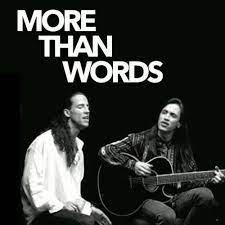
The point of the Extreme song is that love is not something that can be fully expressed in words. Instead the emotion, the affect, the relational connectedness is all “more than words.” This basic sentiment is actually a deeply phenomenological point that is well worth thinking about for a while.
Although Martin Heidegger claims that “language is the house of being,” and Ludwig Wittgenstein suggests that “the limits of my language are the limits of my world,” (and on other occasions, I would be happy to defend these claims in many ways), here I want to highlight the ways in which language is often a poor tool for expressing the dynamics of lived experience. Let me give you a few examples of thinkers who have made this point in various ways.
One note here is probably worthwhile: I am not talking about theological traditions (negative, apophatic, mystical, etc.) where the discourse itself is only ever an analogical or metaphorical approximation. Similarly, I am not digging into dialetheism and paraconsistent logics whereby one also gestures toward the limits of the traditional logical frames functioning in our language. My reason for this is that I am concerned here with lived experience, not with conceptual possibility. I think it is simply fascinating that for all our precision as a species so adept at science, we only think well about what it means to be beings like us when we acknowledge the ways in which our experience is often irreducible to our expression of it.
Emmanuel Levinas on Ethics
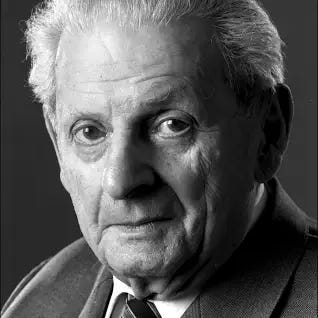
Emmanuel Levinas suggests that our very selfhood is constituted by responsibility to other people. What he means is that we are not first individuals and only later enter relationships of moral significance—as if we could somehow just decide not to be ethically engaged. Instead, for Levinas, we are always already defined by responsibility. Freedom emerges as the option to live into that moral relationship on purpose or to ignore it and live inauthentically in denial.
His way of expressing this is cool. He says that since the ethical relationship is always prior to our ability to reflect on it, it is a “saying” that we will always struggle to convert into a “said.” Levinas’s point is that, when it comes to ethics, the reflective act of bringing something into thematic expression such that we could present it to someone else as a sharable phenomenon is always only after the fact. Our words are “too late” he says for being able to describe the encounter itself. In converting the saying (the lived experience that affectively impacts me and inaugurates my selfhood) to a said (such that others could “read all about it” as if it were a story in a newspaper - or even a post here on Substack!), we necessarily reduce the thing we are trying to describe to something that it just isn’t.
Think about it, how would you be able, adequately, to capture what “happens” in the recognition of another person as a being of moral dignity? No words seem up to the task. They would all be pale imitations. Necessary imitations, sure, but inadequate nonetheless.
Jacques Derrida on Justice
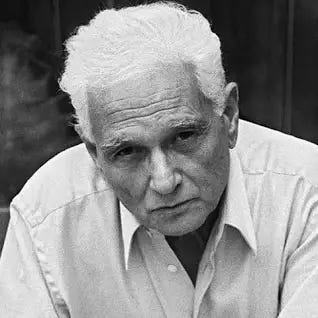
Famously, Justice Potter Stewart, of the Supreme Court, once claimed that he couldn’t define “pornography” but that “he could recognize it when he saw it.” Well, can we say the same thing for “justice”? According to Jacques Derrida, we can’t even “recognize it.” For Derrida, although we can certainly comment on some social acts or events as more just than others—civil rights as compared to racism, say—the notion that X or Y stands as an instance of “justice” is problematic. The issue occurs in that justice names a constant call to transformed living, rather than an achievement that has been obtained at some discrete moment in life.
The way that Derrida tries linguistically to indicate this perpetual task of justice is that justice is always only ever “to come.” Derrida’s point, here, is a good one. Justice is only “just” if it is never “just enough.” That is, justice is constitutively at odds with complacency. Whenever we think we have arrived at justice such that our work is done, we necessarily fail to recognize the very injustice of our assumptions of finality.
Derrida is depending on Levinas’s account of ethics in his formulation of justice, but what really strikes me in relation to our topic today is that “justice” is only ever a term used to gesture toward that which can’t be fully instantiated. Accordingly, justice is never a phenomena such that the term/word would stand as a, to use a technical philosophers term, “rigid designator.”
“Justice” is only ever grasped when it remains more than what our word can say or express.
And yet, if we were to just stop speaking of justice, and living toward that which outstrips our terminology, we would actively contribute to the injustice occurring in the world.
As inadequate as the term is, it is the best option available. But in our attempt to live “justly” part of the project is to embrace that inadequacy as a constant call to keep striving toward justice “if there is such a thing” (as Derrida puts it).
Michel Henry on Living
One of my favorite new phenomenologists is Michel Henry. I am sure that we will dig into his complicated and constructive authorship in future posts, but for now I just want to highlight the way that he understands “life” to be a matter of pure affectivity. In other words, life is not, for Henry, a biological concept, but an existential one. Life is only ever present in “living.” To live is to be affected. Accordingly, living is not available as an object for microscopes and dissection. Cells and bodies are. Life, as such, thus disappears in any objectifying discourse that seeks to explain it as a stable “thing.”
Life is an event. The event of being alive. The event of living.
It might seem that this is just making a mountain out of a molehill, but think about it. I am never able to experience what it means to be alive-as-you. And you are never able to experience what it means to be alive-as-me. Though we can talk about some pan-human structures that accompany all experience described with the qualifier “human,” we can’t ever actually ever understand those structures except from within the experience of living itself.
Kierkegaard gets at this basic idea when he says that existence might be a system (that is, capable of being objectively understood) for God, but it never is a system for an existing individual. We can’t get outside living to articulate what “life” means. And, even if we could, then the term would be necessarily misapplied. Because, as an existential signifier, the term doesn’t actually refer to a “thing” but to an embodied, affective, undergoing.
As with Levinasian ethics and Derridean justice, Henry’s life confronts us as being “more than words can say” (thanks Extreme). And yet, we must keep living into our constitutive responsibility, the call of justice, and the affective dynamics that define our existence. Words may be the “house of being” and the “limits of our world,” in some important sense, but our lived experience should constantly remind us that we can also sleep in tents, as it were, and explore new worlds by breaking free from the “default settings” of what we take to be obvious about the ordinary (I am thinking of David Foster Wallace here).
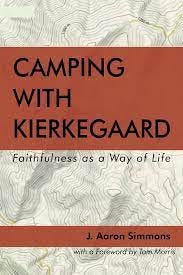
For what it is worth, my encouragement to go Camping with Kierkegaard in my recent book (grab a copy if you have not read it - it is for a popular audience) should be read as a reminder that we should get out of our particular “house” and head to the mountains where adventure awaits in unexpected and unpredictable ways.
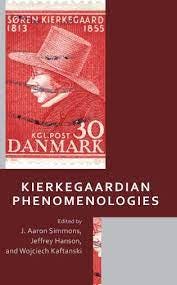
And, my new co-edited book on Kierkegaardian Phenomenologies (don’t buy this one, it is too stinking expensive and also written for academics) is an attempt to highlight these points of resonance between phenomenological nuance and existential awareness.
Philosophy Can’t Do Everything
I love being a philosopher, but it is important for us all to avoid the temptation to think that whatever our speciality is that it can speak to everything for everyone. Philosophy is a very important discourse and has some very powerful tools for thinking carefully about things that matter. But, often its commitment to argument, conceptual nuance, and linguistic precision can lead to thinking that existence is reducible to an argument. But it is not.
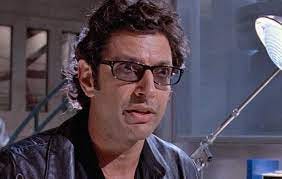
The character, Ian Malcolm (played by Jeff Goldbloom), says in the original Jurassic Park film, “life will find a way.” Well, philosophers might add, “because life will always outstrip our arguments and attempts to pin it down in concepts and language.”
And yet, not everything is, or should be, philosophy.
When philosophy stands as a testament to failed attempts at adequacy, poetry stands as a bastion for the excessive, the overflowing, and the uncontainable.
Poetry never claims to be adequate, but is strategically underdetermined. And maybe that is its particular strength. It “speaks” where words often fail.
Let me give you just a couple examples of poems by my favorite poet, Atticus (not my son!) that do an exceptional job of somehow presenting lived experience in ways that actually testify to the fact that lived experience often stands out as being “more than words can say.” These poems come from his books The Truth About Magic and Love, Her, Wild.
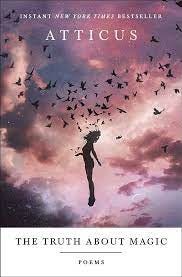
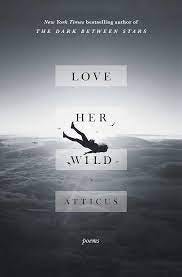
Listen to his description of the investment of love:
“I will follow you,
my love,
to the edge of all our days,
to our very last
tomorrows.”
Or his encouragement in the face of anxiety and loneliness (two concepts that existential philosophers have written numerous books trying to think through):
“You think you are alone
but you’re not
we are here
and a million others too
all scared
all confused
all worried it might never change
but here is the big secret
the one they don’t tell you
you’re doing it right
just by living,
and everything
will be okay.”
And, finally, his explicit presentation of the failure of words ever to “say” enough:
“The words never meant much
that’s not how I loved,
it was when she stroked my hair
when she thought I was asleep
that I knew she really did.”
Yeah, that gets it just right and conveys so very much more than words . . . well, at least more than philosophy is likely to be able to say.
If you are a paid subscriber, let me hear your thoughts about the notion that lived experience often pushes us toward the limits of language. Also, I would just love for you to share your favorite poem! Come, let’s walk and talk along the way.
Please share this post with others so that we can invite others to walk the trails of life with us.
Thank you so much for supporting my work. If you have not subscribed, please consider joining the philosophical community we are building together.
When my first child was born and I heard her first gurgling cry, I became a “Mother”. I had spent months planning and preparing to be a mother, but had no idea what it meant until that lived moment.
Aaron asked me* to give a little speech I'm going to call: The Point and Power of Poetry-
It is in the moments of having life (and it’s lived-ness) thrust unceremoniously into my face that poetry becomes the last and only linguistical tool that makes any sense to me - specifically because the crux of poetry is its apophatic nature. It is then, when words are for the foolish, that words become exactly the tool I turn to.
In the intentionally anti-precise, I begin to find a way out of the mind-ghetto that this experience has found itself lost in... a way to express the details by speaking almost anything but. To turn the words into something TO EXPERIENCE instead of wasting my time in explanatory verbal wandering ABOUT something I experienced.
It is then my privilege to trust that the same Spirit that breathed into me this piece of the Great Happening, will be faithful to complete/carry on its pneumatological work of transcendence in a way specific to the needs/capacities of the next participant in this Divine Dance.
*J. Aaron Simmons did not say that. But he’s said other stuff so...