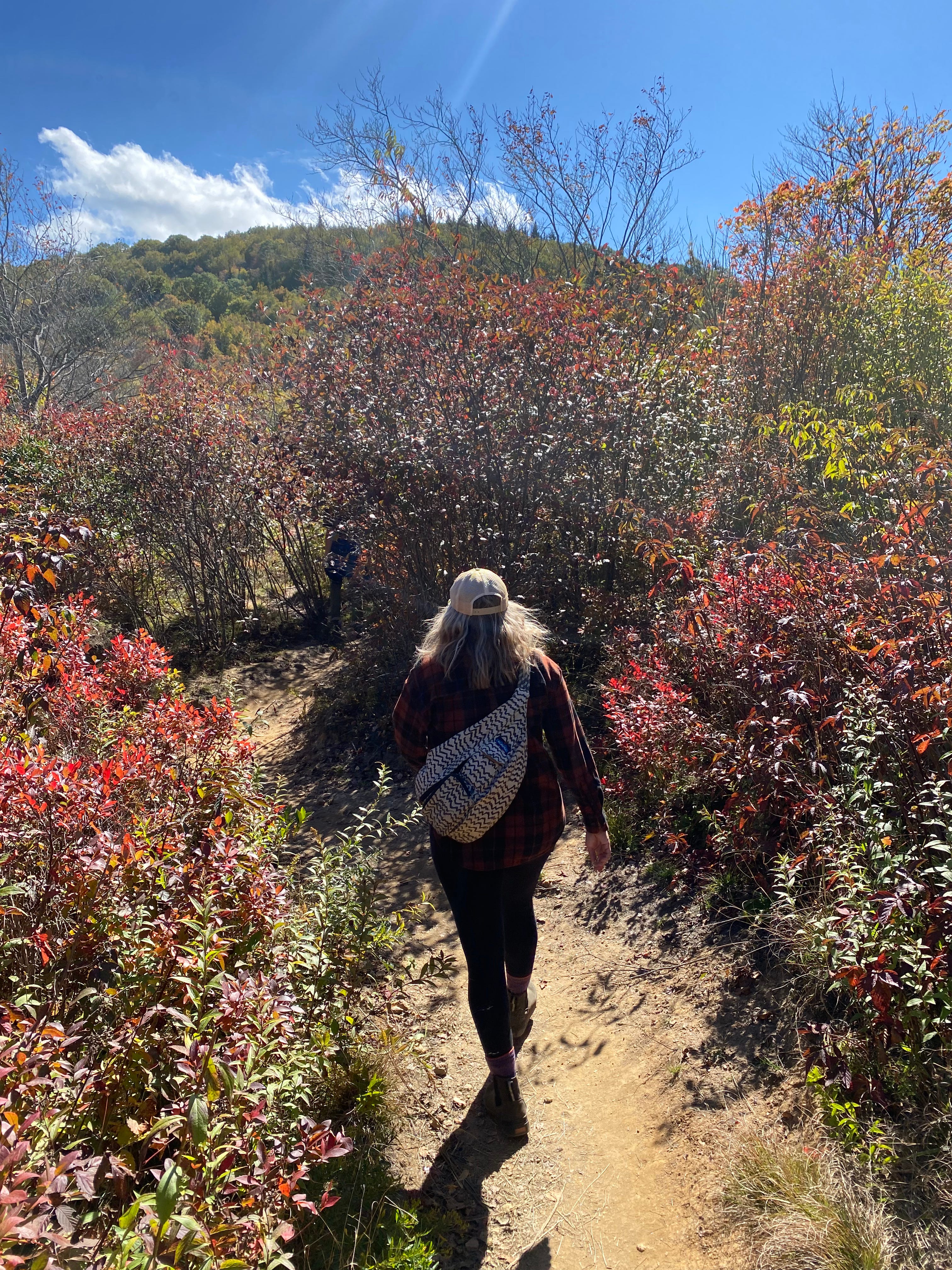
Walking with Philosophers, Or Why Influencers Usually Suck on the Trails
One of my graduate school mentors, David Wood, used to start philosophy classes by paraphrasing Henry David Thoreau by saying “If you want to go for a walk, you have to be willing to get lost.”
David’s point was that philosophy was a lot like going for a walk. We have to be open to “getting lost” in ideas such that questions go all the way down. If we are willing to be critiqued, but only up to a point, as it were, then we are ultimately not doing as Socrates instructs when he says that we must follow “our beloved” (truth) “wherever it leads.”
Going for a walk, like doing philosophy, is not about simply heading over to the pub down the street, or making our way to a meeting across town, or even getting in a quick 5 mile jog that brings us back home so we can grab a shower before work. No. Walking, like philosophy, is a matter of cultivating openness.
Openness to what comes.
Openness to what we happen to find.
Openness to where we might end up.
Openness to what is possible.
Sure, it is possible for us to have a general sense of where we are going. I mean, think about it, going hiking without a map is a very bad (and dangerous) idea. Preparation collaborates with expectation. Notice, walking doesn’t mean that we will get lost, but just that we are open to the idea that getting lost might happen. Philosophy works the same way. In most conversations, arguments, or discussions, whether occurring while talking with other people or simply while reading a book and wrestling with the ideas being presented, we certainly don’t start from zero. We always meet ideas with ideas we have already met (and adopted). And yet, philosophers, like walkers, must be willing to change their views, radically transform their beliefs, and receive transformative criticism about their ways of life.
It is almost always the case that my favorite hikes have been those where I didn’t exactly know where I was going. Again, I was not without absolutely any idea of my direction - I could see the indication of a waterfall on the map generally a few miles north of me, etc. But, the best hikes (to my mind) are always the ones where I see things for the first time. Where every step is covering new ground. Where turning around or continuing on always carries a bit of risk and is accompanied by some indecision. I mean, just a bit further and I might really find something amazing!
Similarly, the most impactful moments of philosophy for me are the ones where I encounter new ideas, critiques, challenges, or opportunities to see things differently. Accordingly, philosophers must be willing to get lost in the effort of finding truth, goodness, and beauty.
Let me see if I can put this all a slightly different way.
Influencers and Philosophers
The difference between being an influencer (which Plato would have termed a “sophist”) and being a philosopher, is that whereas influencers think about ways to get others to think the same way as they do while taking on modes of living that reflect the taste of the influencers themselves, philosophers seek out people who help them think truthfully and live virtuously.
In other words, influencers set out to replicate themselves. Philosophers set out to figure out who they should be.
Influencers usually make for horrible walkers because they always have to know where they are headed and when they will get back in order to decide if it is “worth it.” Philosophers make great walkers because they are never sure where things will end up and even if they come back to the trailhead where they started, they are never unchanged.
For philosophers, the walk, itself, is what is “worth it.”
For the influencer, typically only if the walk leads to more followers, more status, more applause is it of any value.
Sadly, we live in a culture where influencers literally influence everything. Walking, hiking, biking, etc., have all become matters of instrumentally valuable public displays, rather than moments of intrinsic importance.
Finding ways to break free from such “influence” is crucial if we are to be people who strive for meaningful lives, and not just folks who confuse meaning with living such that other people are jealous of us.
We must find ways to “get lost” amidst the gravity of the crowd. Living philosophically requires active resistance to the inertia of the everyday.
So, how can we engage in practices that facilitate such meaningful living?
Well, I actually think that literally going for a walk is a darn good option for those wanting to interrupt the influencers who tell us that philosophy is “useless” and unhelpful for “the real world.”
Interestingly, philosophers have frequently pointed out that often the first step toward transformation is restoring the ability even to consider other options as available at all. Our influencer culture is designed to make such options seem impossible. It is sort of like someone who says that they want to start hiking but whose friends start pointing out to them that they don’t have the fitness, the endurance, the cardio health, or the right shoes, the right gear, or enough time to do so.
Becoming a hiker doesn’t depend on buying out the backpacking section in REI, but it does require getting up and going outside.
Becoming a philosopher doesn’t require a Ph.D. from an ivy league school, but it does require refusing the obviousness of what most folks take for granted.
I sometimes get asked what the “best bike” is for someone getting started in mountain biking. My response is always, whatever bike you have.
However, even if we don’t need all the “right gear,” it is nice to have some encouragement. A friend who says that they will meet us to walk around the block, or to help us get the bike tires pumped up is truly a blessing.
To that end, let me recommend a truly fantastic book that might be a helpful companion as we learn to walk (and think and live) together.
A Philosophy of Walking
The book is Frédéric Gros’s A Philosophy of Walking


This book is a rich journey through the history of philosophy with thinkers who, themselves, loved walking. There are chapters focusing on Nietzsche, Rimbaud, Rousseau, Thoreau, Nerval, Kant, and Gandhi. But, between these chapters focusing on famous philosophical walkers, there are chapters where Gros lays out his own constructive philosophy of going for a walk and why it matters for a joyful life.
Let me just highlight two ideas that he mentions at the opening of the book: 1. Walking is not a sport, and 2. Walking facilitates freedom.
Walking is not a Sport
Gros rightly understands that walking is almost a revolutionary act of resistance in the context of a culture where competition defines value. He notes that whereas sport keeps score and is always about trying to win over others, and where winning motivates entire economies of production and labor, walking is merely about “putting one foot in front of the other.” Rather than winning, walking leads to “no result.” Genuine walking eschews a concern for achieving the status of “King of the Mountain” on Strava.
Indeed, walking is precisely an inverted logic. It is not about going faster, doing more, being more productive, and gaining more status. It is about “the best way to go more slowly.” Here Gros taps into an idea articulated by Ludwig Wittgenstein. Wittgenstein suggests that philosophers should greet each other with the words, “Take your time.”
I love that. Take your time. Go slowly. Stop thinking that success is the goal. Find the time to be invested in faithfulness.
Gros and Wittgenstein both encourage us to rethink the pacing of the ordinary. Some songs are just better when slowed down. Not everything needs to be made for dancing. Sometimes, it is not just ok, but maybe better, to let ourselves not be in such a hurry.
Thinking well takes time. Going for a walk reminds us in our very bodies that we are meant to think well as a lived practice. Influencers will all be unemployed if we all begin to take our time. Maybe if they didn’t feel the need to produce so much content, then they would realize that they should walk more and, thus, learn to produce content that matters.
“When you are walking, there is only one sort of performance that counts: the brilliance of the sky, the splendour of the landscape.”
Amen.
Walking facilitates Freedom
Gros also builds on the idea that walking is not a sport by reminding us that it, like ancient philosophy, is meant to facilitate freedom.
He suggests that there are three sorts of freedom that walking occasions.
First, there is what he terms “suspensive freedom.”
This is the sort of freedom that we find when we are able to “throw of the burden of cares” and “forget business for a time.” I don’t know about you, but yeah, I definitely need to suspend some of the assumptions that I so easily carry with me most days. Assumptions about what matters. Assumptions about what is worthy of my finitude (see my new book Camping with Kierkegaard). Assumptions about where I think I need to be going.
Yet Gros so profoundly reminds us that “only walking manages to free us from our illusions about the essential.”
The hope is not only that we are able to suspend our normal assumptions, but that we actively become “alienated from speed.”
A couple years ago, during the midst of the pandemic, I wrote an essay about the phenomenology of patience. My argument was that one of the possible silver-linings of the otherwise miserable and traumatic situation was that, as a culture, we could begin to remember that patience is a virtue. Well, though I do think that this has become activated in my own life (due to lots of effort and specific decisions to resist the “return to normal”), I think that we missed this opportunity. We are now back to a world where immediate gratification is the best kind and 2 day Amazon delivery is simply too slow!
Ugh.
Oh, for more chances to walk and allow my world to “collapse” along with “those connections” within the world that now (while on the trail) seem to be “burdensome, stifling, and over-restrictive.”
The second kind of freedom is what we might call primitive freedom.
Here, the freedom is found not in “finding ourselves” but in losing ourselves in the wildness of a natural world that is indifferent to our worries. “The freedom of walking, “ he says in this regard, “lies in not being anyone; for the walking body has no history, it is just an eddy in the stream of immemorial life.”
In an age where more is better and new is the only serious choice, it is freeing to be where both history and future meld into the present moment in which beauty participates.
Finally, there is the “freedom of renunciation.”
This third notion of freedom is something of a vision of what real transformation might involve. Suspensive freedom is a break from things that we then go back to (with more energy and purpose). Primitive freedom is a break in the way that we think about ourselves so that we then can return to our daily activities with a better sense of our limits and our depth. The freedom of renunciation, however, is not about getting back to things, but about no longer being defined by such things at all.
Gros says that this final idea of freedom is likely to be facilitated most by very long walks such that we lose sense of any “normal” to which one would return. The only “normal” in play at all is the next step. His point is that what counts as “normal” is radically contingent. We can do things otherwise than we currently do them. The influencers can be silenced as we listen to the sound of the stream, the call of the birds, and the wind in the leaves.
Finishing his section on the freedoms of walking, Gros writes the following:
“You can hardly remember where you are going or why; that is as meaningless as your history, or what the time is. And you feel free, because whenever you remember the former signs of your commitments in hell—name, age, profession, CV—it all seems absolutely derisory, minuscule, insubstantial.”
C.S. Lewis says at the beginning of The Great Divorce that competition is the philosophy of hell. Well, here Gros is reminding us that so very much of our daily lives is hellish. It is about achieving more and more and more. It is about being better than them so that they want to be like us. It is fundamentally about egoism that masquerades as virtue.
Thoreau said that most folks will live lives of “quiet desperation.” I think he was right. If we can focus on the fact that our resume is better than someone else’s, then we don’t have to pay attention to the fact that we have traded selfhood for a job. Tragically, most of us actively live such that we can remain oblivious of our own misery.
If you want to hid in complacency, then don’t go for a walk. Go watch some influencers instead.
But, if you are ok being willing to get lost, if you are ok with thinking deeply and being transformed in the process, then grab your water bottle and let’s go.
The trails of life await.
As always, I would love to hear your thoughts about the things I am thinking about! If you are a paid subscriber, drop a comment and let’s think together. If you have not yet joined at the paid level, please consider doing so. But, no matter why or how you are here reading and thinking and walking with me. I am deeply grateful for you.
Additionally, please share this post so that we can grow our community of folks who want to live on purpose and find joy on the trails.


What came to mind here is also the difference between bounded and centered sets. If we are willing to get lost, boundaries are much less important than the centers that help us find our way. Getting lost in ideas is my love language because I am always surprised at where I may end up based on the beginning. The beauty in wandering in the woods and in ideas is that we do not experience the urgency of timetables and destinations.