
What Counts as "Philosophy"?
A Personal Reflection on Professional Discourse

A former student of mine recently reached out and told me how much he enjoys my posts here at “Philosophy in the Wild.” However, perhaps because he likes that the tables have turned since I was his professor giving him critique on papers, he told me that he thought I should do less “here is a story about my family” and instead do more “real philosophy.” Ha! I completely get his point and it is a good one.
Well, sort of . . .
Although I admit that in response to his challenge I was tempted to make this post entirely about the nuances of analytic mereology or epistemological debates regarding “modest foundationalism,” say, I then started thinking about the assumption operative in my former student’s comment. Whether he realized it or not, he was tacitly claiming that there is lots of stuff that is too light, too ordinary, or too personal to count as genuine fodder for philosophical inquiry. The stuff of philosophy, he basically suggested, is technical, difficult, hard-edged, and objective.
I willingly admit that lots of what professional philosophers (like myself) do, does rightly fit into such a description. And this is actually a very good, and important, thing. In a time when expertise is being rejected in favor of crude preferences for wealth, and when the hard work of becoming a specialist is thrown out in the name of political loyalties, it is crucial that we not ignore the social value of technical work done by serious people about difficult things.
Indeed, I don’t want my dad’s neurologist only relating to issues in ways that are accessible to the general public. I don’t want my truck mechanic to consult manuals that someone without training could easily understand. I don’t want someone re-roofing my house or fixing my plumbing after watching a few YouTube videos.
Expertise matters and should, in some significant way, be “exclusive” to those who have put in the years of training, learned the technical vocabulary, and engaged in the embodied liturgy of repetition that fosters the honed development of their singular skill. Why would we expect such expertise of our physicians, our mechanics, and our craftspersons, but not expect it of our philosophers?
Surely our minds, our thoughts, our beliefs, and our reasons are as important as our bodies, our vehicles, and our houses.
So, again, I think that my former student was definitely on to something in his desire for me not to “water-down” the philosophy to make it accessible to non-specialists.
And yet . . .
Even though we need to celebrate philosophical expertise, there is something really cool about philosophy that is, to my mind at least, less prominent in other fields: almost everything (and I mean everything) can be philosophically interesting!
We don’t go to neurologists to change our oil. We don’t call plumbers when we are having headaches. We don’t reach out to mechanics when a hail storm has caused a leak in our ceiling. But, we can think philosophically about the relation of our brains to our moral sensibilities, about the transformation of our embodiment with the advent of new technologies, about the significance of “place” in relation to what we call “home.” And so on.
My point is that philosophy is about much, much more than a professional discipline reserved for experts. Without wanting to take anything away from the rigorous work done by my colleagues within that discipline, I just don’t see philosophy as narrow in the way that so many other fields are. Indeed, at its most general (and existentially viable level) it is about living on purpose and learning to breathe deep while living. In this way, philosophers take seriously what everyone else takes for granted. Or, as I often say, philosophers put question marks where most other folks put periods. In this way, I think that philosophy should always be personal, whether or not it is done by professionals.
Let’s just do a little bit of this expansive work together.
Consider the following two pictures:


Both of these pictures are deeply “personal” to me. When I look at them I admit that I almost tear up thinking about my son no longer being the cute little kid who insisted on wearing his magic cape and the wolf ears while we were on vacation in Vermont so many years ago. He is now a stinky-butt teenager and much more concerned with his “fit” (read: clothes) and his weekend plans with friends than he is about spending time listening to bedtime stories about imaginary places where animals talk and he has the ability to fly.
It is surely possible just to see these pictures as a distraction from the “seriousness” of philosophical inquiry. Or minimally we could see them as just irrelevant to such “objective” professional work. But, I think we would be wrong to do so. Indeed, I think doing so would likely make us bad philosophers.
These pictures are my attempt, as a professional philosopher, to illustrate several complicated philosophical ideas in ways that ground them in my lived experience. The point is not to tell you about my life, I am sure you have more interesting things to think about, but to invite you to think more reflectively about your own life.
Let me give you just a few examples of philosophical principles that these two images might help us to understand--were we to spend the time pursuing the thoughts:
There is no sense of selfhood without a temporal location (Heidegger, Nietzsche, James).
The idea here is that there is no “you” or “me” except in a context that is, itself, historically positioned. I am, to some significant degree, the performance of a story that I continue to tell about who I am. But just like you cant pick up a novel and begin to read on whatever page you want and then flip to whatever other page and keep reading, our selfhood emerges as an extended coherent narrative that needs a history and also a future. In fact, ask yourself whether you would be doing what you are doing if you did not think that the world would exist two weeks from now? Moreover, ask yourself who you would be if things had been radically different for you over the past 10 years, etc. Who you are/I am is not some sort of transcendent objective state of affairs. You are/I am in process. We are always becoming. And we only become right where we are. When is often the framework for Who.
Existence is not only fundamentally relational (Hegel, Whitehead), but a matter of responsibility (Levinas, Derrida, Beauvoir).
Perhaps the best way to explain this is that we are not at first free beings without moral constraints, but moral beings who navigate their freedom in social contexts. I am not “me” and then have some responsibility for my wife, my son, my students, my neighbors, etc. It is my responsibility (and the specific ways that it plays out in historical contexts) that constitutes who I am.
To care about others requires that I be invested in my obligations to future generations (Petit, Sartre, Rolston)
My actions are not somehow isolated in their impact. I am responsible for whatever “world” I have handed over to those who come behind me. The way I often think about this is that “norms norm us.” What I will have allowed to be viewed as “normal” will, in large and small ways, shape what others take for granted as obvious and necessary. Taking up our historical existence amounts also to anticipate how our lives will shape the lives of those who we will never meet. Being narrowly focused on “right now” amounts to a moral failure since what we do “now” will often be received by those who follow us as the “right” thing to do. Think about how often we hear that “this is just the way things are done” really amounts to “that is how we have always done them.” Existing in moral community requires being invested in opening spaces for the moral flourishing of those who inherit our influence. I think about this a lot when it comes to taking seriously that my son watches me as a model of how to live and who to become. I hope that I can bear that weight well.
My identity is essentially located in a social community in which not only meaning but also justice are formed and enacted (Nussbaum, Arendt, West, Aristotle).
Our moral lives are not isolated from broader social frameworks. Cornel West has claimed that “justice is what love looks like in public.” I think he is right. We are unable to set aside the political in order to “get along” with our friends and family. As Aristotle rightly understood, the “polis” (community) is what shapes who we become and it is where we either cultivate virtue or vice as acceptable for our social world. Justice is not an afterthought for existence. It is the bassline and drumtrack over which our lives are the improvisational performances that make us who we will have turned out to be.
Knowledge is to some significant degree a matter of experience (Locke, Hume)
Novelty is often cool. Innovation is usually fine. But it all depends on that toward which one is moving and the ideals in relation to which one narrates progress. It is only by the long persistence of effort that we learn how better to spend our time. I am not sure I am a good father (though I am trying to become one) but I know I am a better one than I was when my son was 2. I have now had 14 more years to figure things out. The “hard fought hallelujahs” of which Jelly Roll speaks are not usually to be found in graduate school or medical school classrooms. But the lessons learned in those classrooms are often what allow us to be better interpreters of what hallelujahs are worth fighting hard for in the first place.
Some things are just felt more deeply than words can express (Chrétien, Marion, Henry)
As much as I love words, and I probably use far too many of them far too often, I think almost everything that matters most in life happens at the level of affect more than it does at the level of cognition. Maya Angelou is right to say that they will forget what you said and what you did, but they will never forget how you made them feel. I want my son to feel loved - whatever lecture I might give him about the importance of the four conceptions of love for reflective existence.
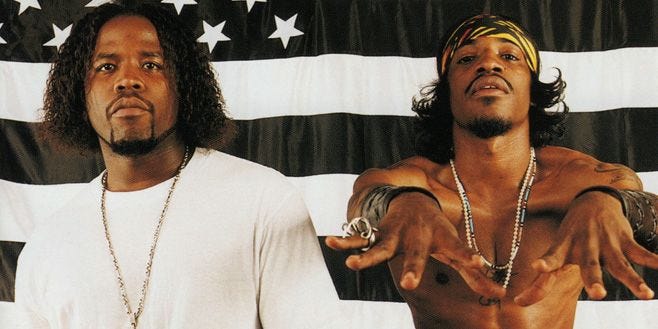
The list could go on, and on, and on. As Outkast says, “forever? forever ever? forever ever?” Yeah, forever.
Philosophy does not admit of easy limits when it comes to its domain. If it is about life, if it is about truth, if it is about value, if it is about existence, if it is about subjectivity, if it is about meaning, if it is about language, if it is about belief, etc., then it is where philosophy can happen.
What matters, though, is how we relate to what we so often ignore. Are we reflectively aware? Are we willing to inhabit questions, rather than move to easy answers? Are we interested in slowing down in what we are doing, rather than trying ever more quickly to be done with it?
I deeply respect my former student and consider him a heck of a philosopher, but I think he, like almost all of us, is tempted by what I want to term the allure of the exceptional.
Exceptions are interesting, and perplexing, and worthy of our attention, but as I see it, philosophy should more often invite curiosity about the ordinary.
Aristotle says that philosophy begins in wonder--he is right. But, we don’t need to wonder only about extreme case studies, we can wonder about what is right in front of us at this very moment. As the band, Oasis says “all my people right here, right now, d’you know what I mean?” Maybe they were just trying to get us to focus on the majestic possibility that confronts us in the sublimity of the mundane.
As I look, philosophically, yet always personally, at those two pictures of my family, I don’t just think about things differently, but strive to live differently.
That’s the hope expressed by Karl Marx when he says that philosophers are not just those who understand the world, but those who should seek to change in (in light of hopefully an ever better understanding). That’s the realization of Aristotle when he says that it is hard work to be excellent.
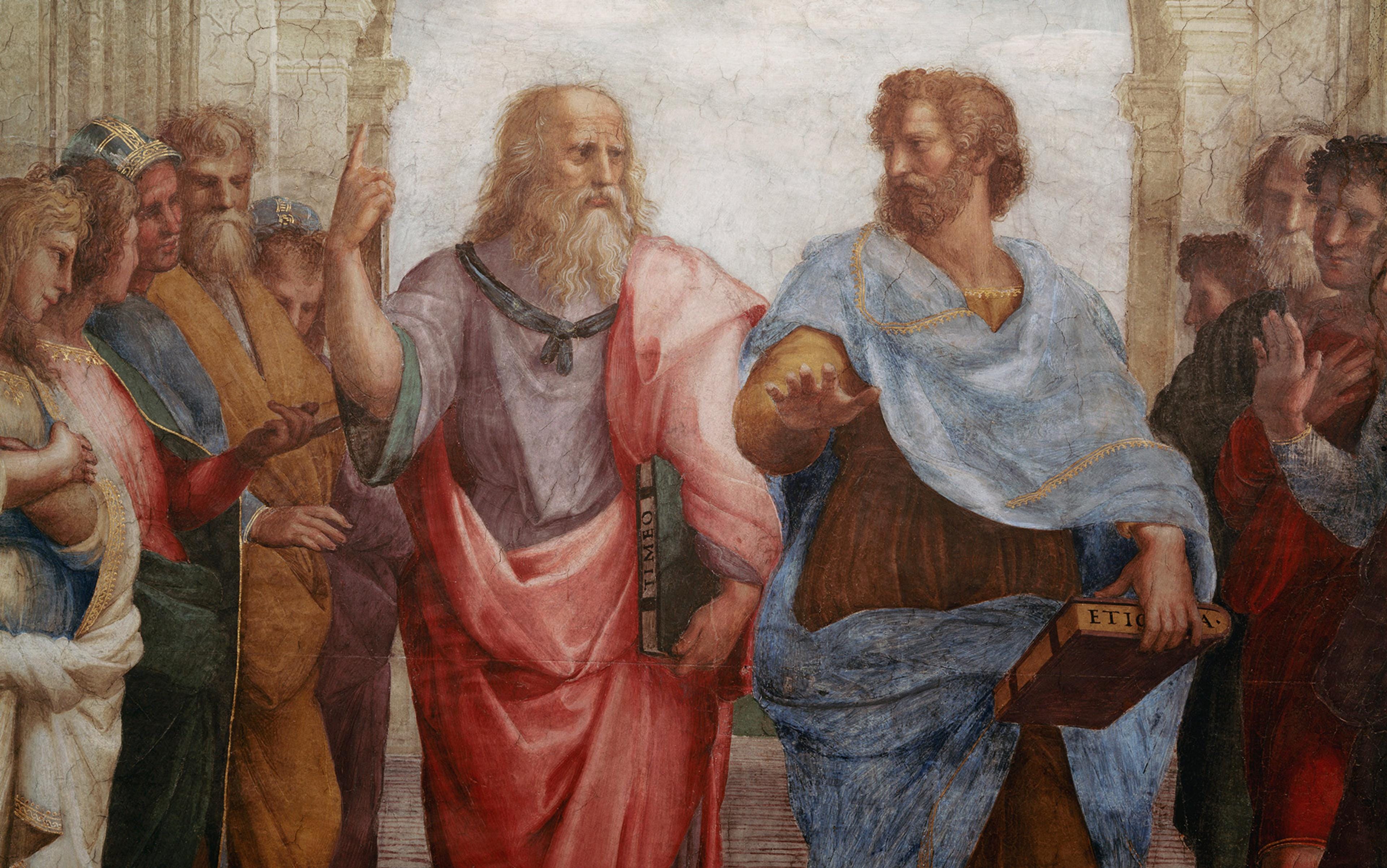
I often think about the famous painting by Raphael, “The School of Athens.” In it, we see Plato and Aristotle walking together. Plato is pointing upwards—indicating his focus on the world of the forms—and Aristotle has his hand opened toward the ground—indicating his focus on our lived practice and social world. I think that we don’t have to decide between them. The point is not, ultimately, which one of them was right about metaphysics, but that they were friends who walked together and talked a bit along the way. It is that conversation, that friendship, that walk that I think is really what philosophy is all about.
Look, in no uncertain terms, I can tell you that it is much easier to get a Ph.D. in philosophy than to become, daily, a good father, a good friend, and a good person. Seeking to do the latter things cultivates important humility as I live into my professional identity.
So, to my student I simply say, give me a call anytime and we can talk modal logic. Then, as we finish our conversation, I will remind him that even if he figures out all the deep philosophical questions but fails to live a life defined by truth, goodness, and beauty, then he may have missed the most important point.
Don’t believe the lie that you can’t do philosophy because you didn’t get a college degree. Don’t give in to the temptation to think that what you do daily, in your home, at your office, or wherever you find yourself, is somehow less important because it is too pedestrian. Instead, as Kierkegaard says, we should attempt to “find the sublime in the pedestrian.” That’s simply what philosophers do (whatever their profession).
Here, at the beginning of summer we must be aware of the fall semester yet to come, but we must not, thereby, miss out on all the days in the sun.
Similarly, as I look at my son I must be aware that if I am too filled with regret for not making more of the time with him at 7, I will quickly find myself having missed out on making the most of my time with him at 16.
Go do philosophy. Right now. Live on purpose. No special degree needed.
Maybe it is my age, but I get uneasy when we try to separate our lives from our philosophy. If unhitched then there seems to be a danger in making the two so separate that philosophy means nothing. Much like our morals expose our ethics, our actions expose our philosophical view of the word. Plus, story is more powerful than pure knowledge.
I wholeheartedly agree. Probably since I prefer a process metaphysics where my orientation is experience rather than propositions.