
Why I Don't Do "Debates"
And Neither Should You!

I get that the title of this post might seem a bit odd coming from a philosopher. Isn’t “debating” what philosophers do for a living? Well, it all depends.
Maybe you are familiar with the classic Denzel Washington film, The Great Debaters. This is one of my favorite scenes of the film and it gives a good indication of what we might mean by “debate” - a formal and public consideration of different sides of an issue with the goal being to give the very best possible arguments for the alternative views available.
It is this conception of debate that I fully support and, it is in light of that notion that I did a YouTube video a few years ago about why debates matter in deliberative democratic societies:
I wholeheartedly think that it is crucial that such public engagements about complicated issues should happen and we should expect that the participants in them be epistemically well positioned in relation to the topic under consideration.
The thing that matters most about such debates is that they are opportunities for the public to witness what good argumentation looks like. They are events where what matters most is getting to the view that is best supported by the evidence and so the debate is an occasion to consider what that evidence is.
Good examples of debates are where the participants are evenly matched in terms of argumentative ability and epistemic virtue. They all must be committed to truth being more important than simply being perceived as right. They must affirm that persuasion is not what really matters; being convinced by good reasons is.
If this is what debates looked like in our broader culture, then I would see them as a positive phenomenon for a world desperately in need of a more robust public commitment to reason-giving and virtuous discourse.
However, that is not what “debate” tends to mean today. Instead, a “debate” almost always has three characteristics that actively make them corrosive to our social flourishing and epistemic development.
First, truth no longer matters.
If you have watched any political “debate” in recent years what you will find is an absolute disregard for truth and only a concern for winning. The goal is not to model discursive virtue, a commitment to the epistemic equality of those with whom one disagrees, and what it looks like to be motivated in belief and action by good reasons. Instead, they are instances of largely manipulative rhetoric aimed at making the other person look bad in order that you look good. If winning is the goal, then quickly whatever gets you to that outcome becomes justified in the course of the event. And yet, we must be like Socrates who says he prefers nothing unless it is true. Even if we tweak his claim to say that we should prefer nothing unless it is well supported by the best reasons available, the point is the same: A concern for winning distracts from what matters and serves to seed epistemic vice as a social norm. I am not suggesting that politicians, say, should not be trying to win their election. I am simply saying that we should expect that anyone worthy of entrusting with such social power cares more about what is true/well justified than what is simply beneficial to their self-interest. Indeed, if politicians are not motivated by the rational stakes of the public good, then they are active threats to the very society they are hoping to lead. Political debates should be spaces where we get to assess such epistemic commitments, social priorities, and the virtues required for leadership not to be reducible to vulgar competition and power-play. It is genuinely a tragedy of the commons, if I can tweak that notion, when we get accustomed to “debates” being nothing more than our candidate beating up on their candidate. In such a circumstance, we should demand our candidate withdraw as unfit for service.
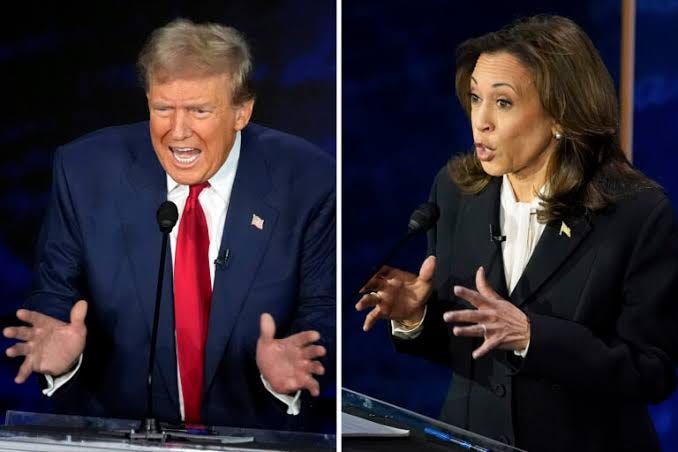
Whenever loyalty to our side means that we are no longer responsive to reasons in other directions, we have lost sight of truth/justification in the name of our own interests. It is this very slide that causes Plato to claim that democracy will inevitably lead to tyranny as the people increasingly give into their appetites rather than their reason. When we are no longer concerned with believing in light of good reasons, we abandon ourselves to our appetites. Moreover, we are willing to be led by those who are similarly driven. Tyranny follows whenever power usurps thinking.
Now, I should make very clear that my comments here do not mean that there are not people who have proven themselves to be so epistemically untrustworthy (so self-interested, or committed only to winning, etc.) that we are no longer willing to hear their reasons. We are finite beings and our time is limited, so we must be judicious about whose voices will influence our own. Accordingly, deciding no longer to take someone seriously as an epistemic equal due to their demonstrated deliberative vice is not a failure of reason, but a manifestation of it.
Second, theatre has replaced thinking.
Let me quickly note that I am not throwing any shade to my distinguished colleagues in theatre departments! Instead, my worry is that what is often framed as “debate” is just a performative manifestation of personality. Sure, charisma matters in all sorts of ways when it comes to trying to get an audience to find your claims compelling, but if we allow charisma to do the work of argument, we have stopped thinking and are now nothing but social performance artists, not epistemic agents doing our best to cultivate cognitive health in our communities. I blame social media, in particular, for this particular flaw in contemporary “debates.” The rise of YouTube and Instagram has led to a world in which whatever gets a bigger audience is, definitionally, good. Energy matters far more than expertise and we all are worse off as a result. Those who host “debates" thus try to find ways to make the entertainment factor the most important thing. The outlet that has perfected this particular approach is Jubilee.


These events (that then get millions of views on YouTube) are basically staged theatrical performances of Survivor-esque conflict framed as “debates.” More of a game show than genuine argumentation, the people invited to be on them are, themselves, almost always influencers rather than experts. Accordingly, nuance gets replaced with shock-value. Technical precision is boring and so whatever fosters the drama of conflict is pushed to the forefront.
Thinking well isn’t a game show. It is the slow labor of social existence in light of our moral responsibilities to each other. Even when someone serious is featured on one of these sorts of “shows,” they are expected to engage with folks who are not similarly serious . . . aaaaannnnndddd there is the drama again. Ugh.
When shock value becomes a means of building an audience and being ever more extreme in one’s views is a tried and true method of brand-development, democracy is screwed. Anything that is called “debate” must stand against such trends, not be used to foster them.
Third, speed matters more than substance.
If you have spent any time on social media lately you will, no doubt, have seen that everything is becoming a matter of “shorts.” Long videos are a thing of the past. If it takes more than 30 seconds to say something, then . . . next!
The science on this topic is clear - the average sustained digital attention span is decreasing dramatically as the daily screen time dramatically increases. This is especially striking when broken down by generation:
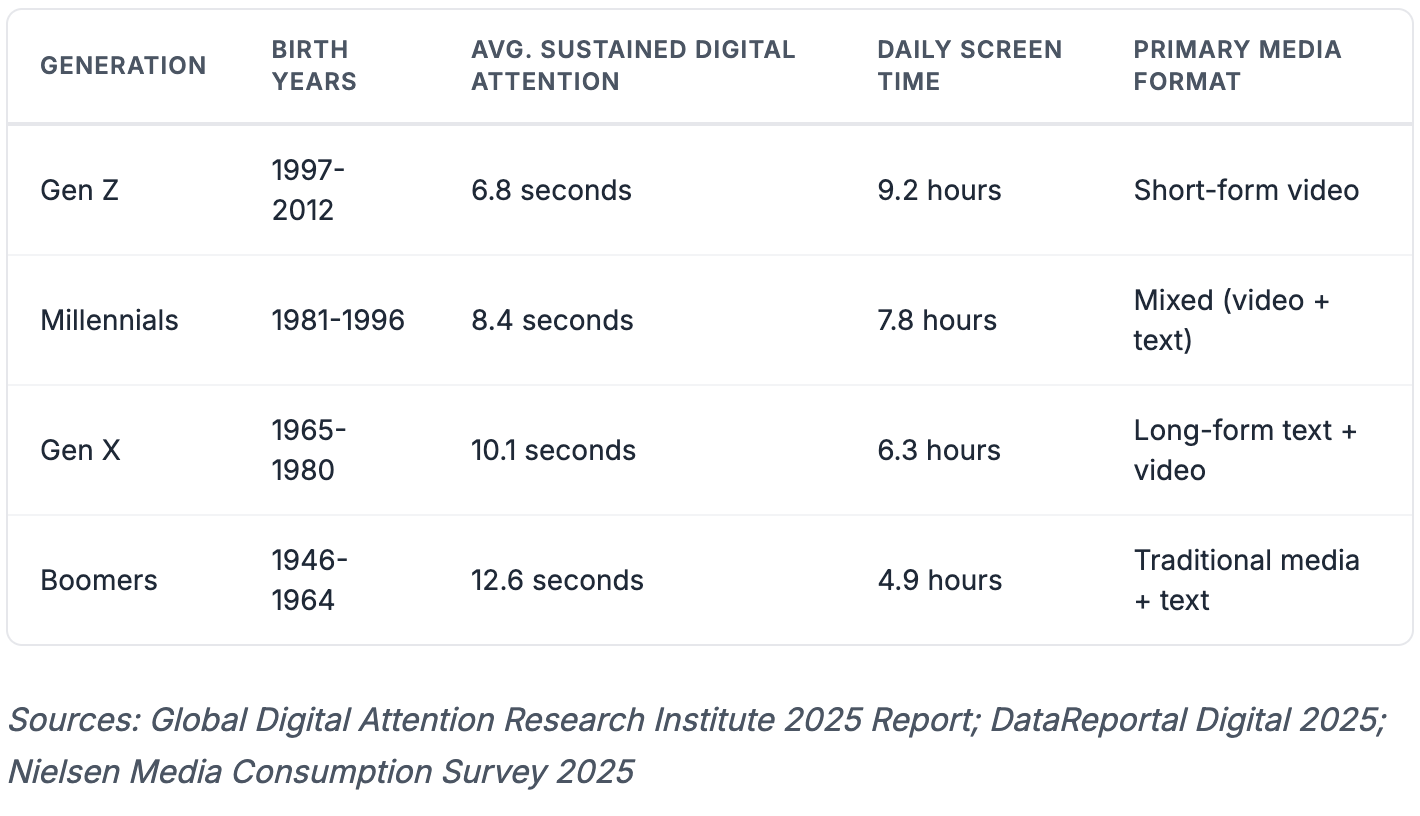
Now, my Gen-X attention span of 10 seconds and 6 hours of screen time isn’t exactly encouraging, sigh, but the point is that things are getting worse, not better. And as the dopamine hits per minute get increased the addiction to scrolling to the next, and the next, and the next thing gets even more intractable. Accordingly, far more people are watching a 30 second clip of one of the “debates” (whether political or otherwise) than they are to watch the extended video. This means that we are also getting increasingly less good at understanding the context in which particular claims might stand as warranted or not. Not only are we getting worse at argument, we are getting worse at putting in the time it takes to think well.
The mathematician and philosopher W.K. Clifford once wrote that if we didn’t have the time to consider the evidence relevant to a particular issue, then we didn’t have the tine to hold a view about that issue. His strong-evidentialist epistemology might be challenged and yet his point is well taken, we want the fun but not the work. We want the outcomes but not the process. We want the performance but not the practice. We want the game but not the training.

Following from Clifford’s point we would do well to reflect on Harry Frankfurt’s claim that bullshit is far more likely to occur whenever people are expected to hold views about things that they don’t understand.

So, in our digital world where speed is more important than substance, we are encouraged by the cultural machine to become bullshitters who build audiences by mocking those who expect us to slow down and do the hard work of thinking well. Indeed, such mockery will likely lead to more views, more subscribers, and more money.
Conversations Must Continue After Debates End
I am a professional philosopher. I also do philosophy in public. Accordingly, I engage in argumentation with people all the time - and almost always there is disagreement displayed in the process. However, I don’t do “debates” because I am unconvinced that real debate is possible today. Instead, whenever I am invited to debate someone about something, I simply turn down the invitation or suggest that we not do a debate, but just have a conversation. The idea is that we must find ways to minimize the politicized performance in the name of the patient work of truth-seeking.
Here’s the thing though, whatever your profession or your background, you shouldn’t do debates either. Don’t engage others as opponents in a battle-royal of winner-take-all supremacy. Instead, invite others to conversation and, so long as they are similarly committed to the importance of thinking well and giving-reasons, you might end up being the one who is transformed in the engagement. Seriously, think about it this way: the conversation can continue long after the debate has ended. A few friends of mine have actually been part of Jubilee events and they say that once the cameras were off, the entire tone of the engagement changed. Rather than oppositional division, there was human connection.
When we see the humanity of each other, we are far more likely to see what we share beneath our deep disagreements. At that moment, true engagement is not just possible, but likely is productive.
But not just everyone is worthy of such engagement. Those who profit from the vice of contemporary pseudo-debat-ertainment can keep walking. Anyone who wants to make sure that they have a film-crew on standby for the discussion is not interested in seeking truth, but in building an audience. Is it possible to do both? Sure, but it can be done virtuously only if the former is the cause of the latter.
Because I don’t do debates I also won’t engage with people on social media when their comments are not good-faith instances of trying to think together. Let me close with a few tips on how to recognize what good-faith might look like here:
Are they avoiding personal attacks or engaging in mockery and insulting rhetoric?
Are they giving reasons for their disagreement in ways that allow for public consideration (and hopefully verification) or are they appealing to conspiratorial gestures that actually undermine trust in the available evidence?
Are they willing to revise their views in light of good reasons, or do they just double-down on their insistence of their own position?
Are they able to appreciate that there might be others better epistemically positioned than they are when it comes to this issue, or have they presented themselves as absolutists in light of their own certainty?
When faced with others who are acting in bad-faith, do they try to show charity (at least initially) rather than just giving in to the snowball of vitriol?
Are they willing to go “offline” to continue the conversation, or is the performance the whole point?
Do they acknowledge dehumanization as a hard-line for being reasonable, or are they willing to let dehumanizing rhetoric pass without immediate condemnation?
There are a lot of other things I could say here, but I think that is enough for today. I do remain hopeful that our society can find ways to celebrate the important role that genuine debate should play in our democratic flourishing, but I am not optimistic. James Cone talks about the importance of finding “hope beyond tragedy,” I think that such an idea is increasingly the best framework available for remaining willing to think publicly about things that matter. The tragedy of the deliberative commons might mean that the tyranny about which Plato warns is now inevitable. But, so long as reason-giving remains an option, let’s commit to it. The only other option, which Simone Weil terms “force,” is not just a case of bad thinking, but very literally an unthinkable future.


I think you summarize the problem with "theater has replaced thinking." That was entirely evident when fellow members of clergy told me over and over how knowledgeable Charlie Kirk was. They did not understand the argument or the theater so they ate at the trough of it.
Come on, Aaron. How are we supposed to monetize thinking if it’s “the slow labor of social existence in light of our moral responsibilities to each other”? And if we teach everyone to think, how are we supposed to emotionally manipulate the masses?